
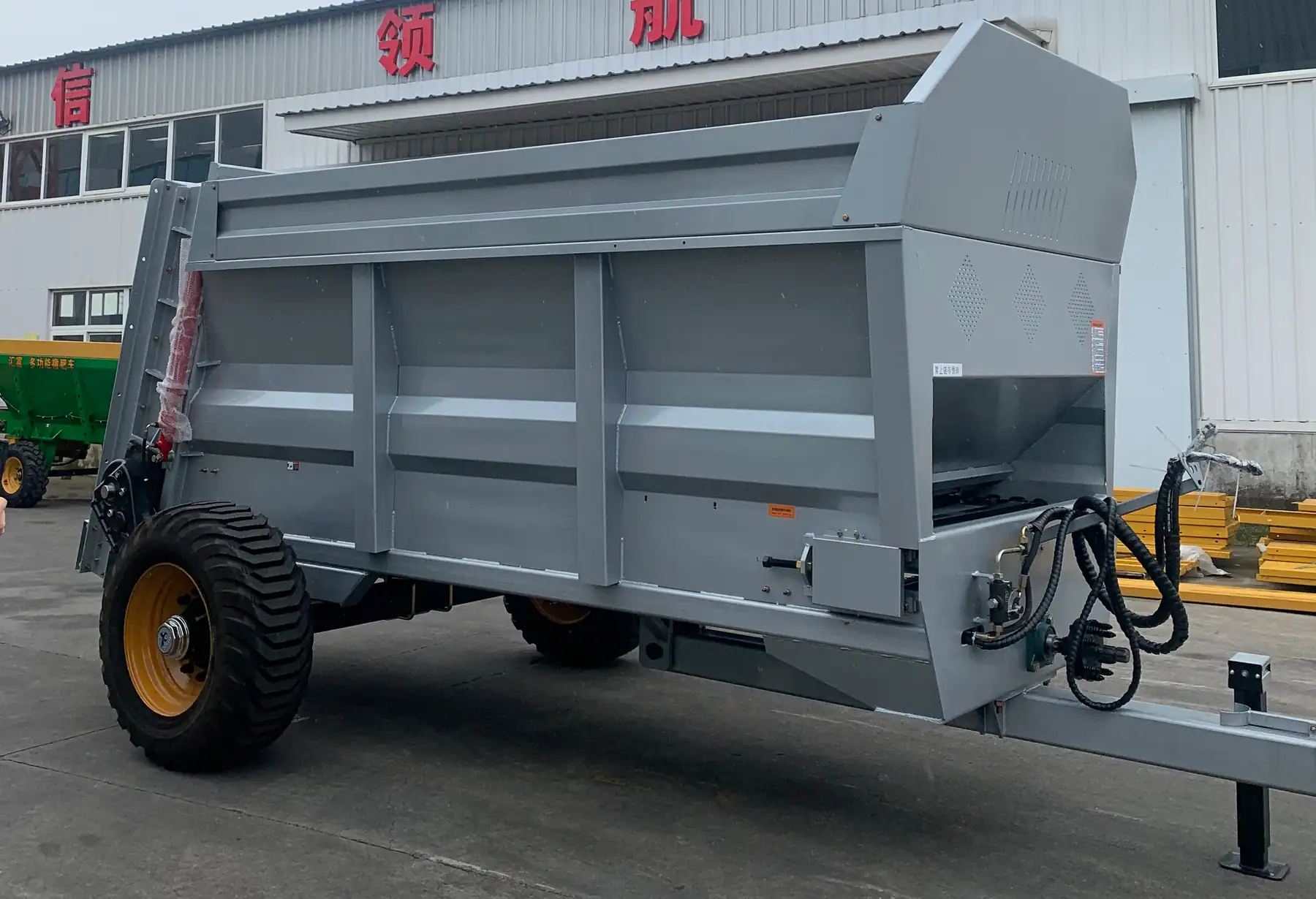
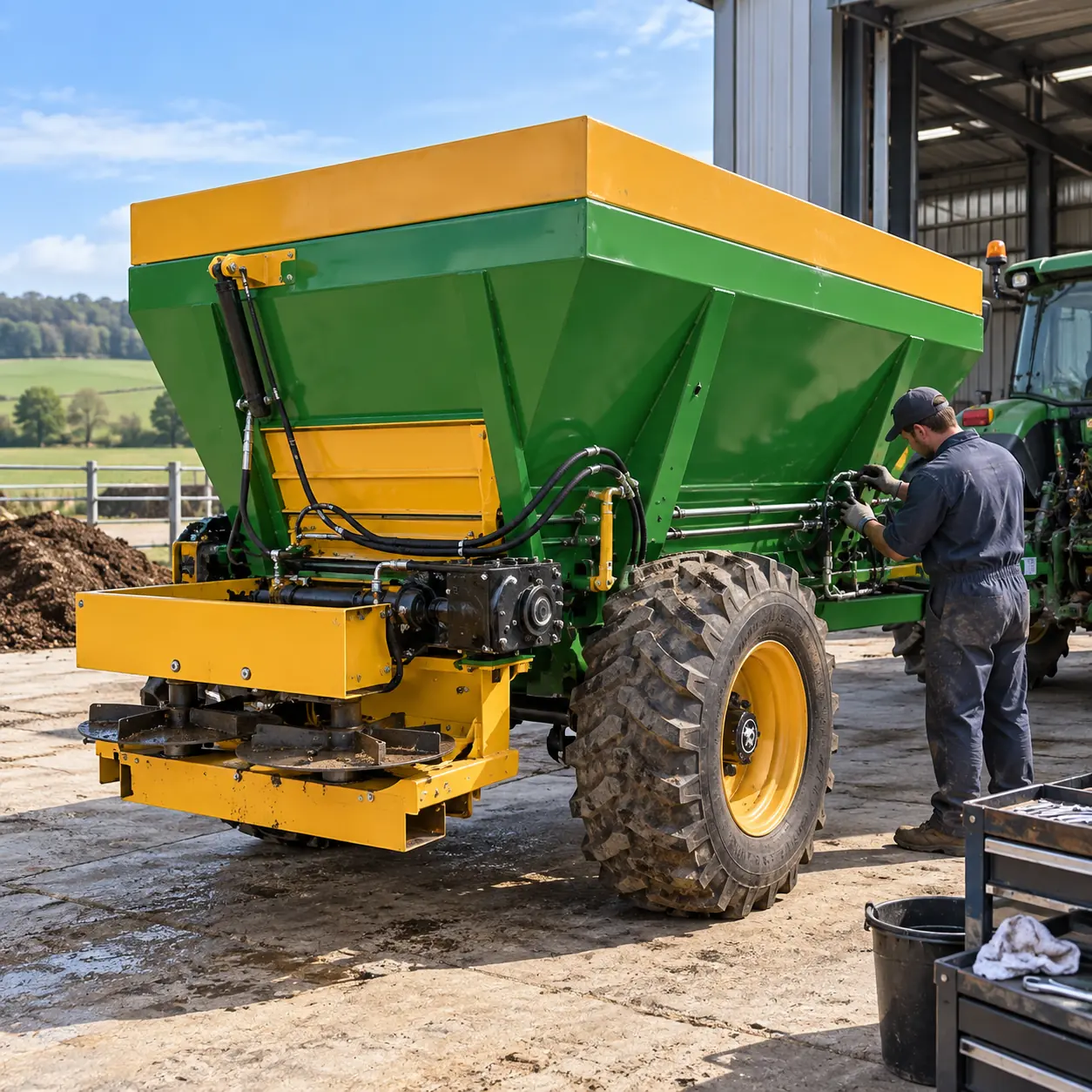
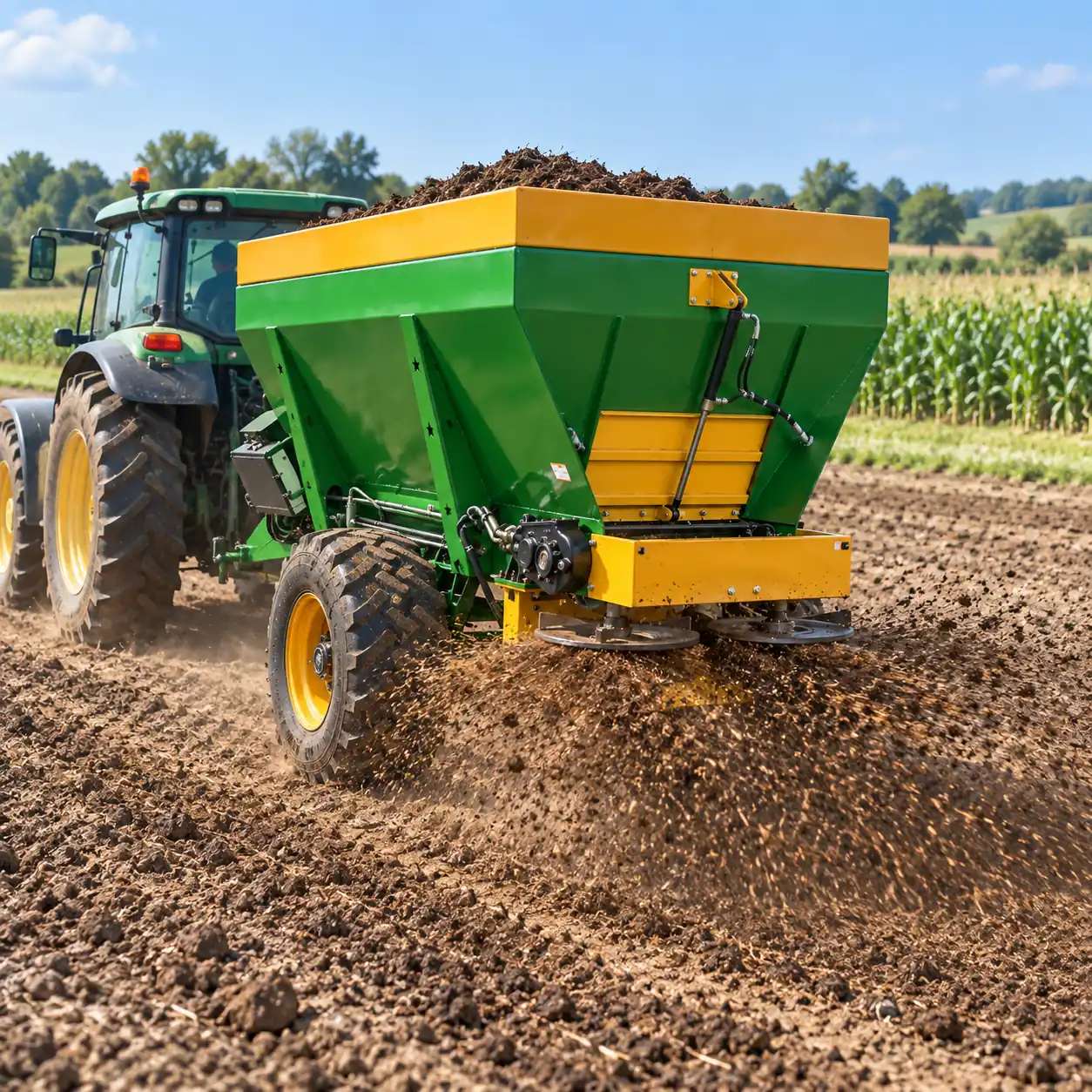
The right manure spreader is not simply the largest model your budget allows. It must match your tractor, material, field access and daily workload. For many farms, the decision comes down to a compact 3m³ machine or a higher-capacity 5m³ machine. Both HUIFU models use chain-board feeding, rear dual discs and an adjustable 6–12 m spreading width, but they are built for different power and payload requirements.
The short answer is straightforward: choose the 3m³ model when maneuverability and compatibility with a 40 HP or larger tractor are the priorities. Choose the 5m³ model when you have at least 60 HP available and fewer refill stops will make a meaningful difference to the workday.
3m³ and 5m³ manure spreader comparison
| Specification | 3m³ model | 5m³ model |
|---|---|---|
| Recommended tractor power | 40 HP or above | 60 HP or above |
| Hopper volume | 3m³ | 5m³ |
| Maximum rated load | 5,000 kg | 8,000 kg |
| Overall dimensions | 4600 × 1700 × 1770 mm | 4987 × 1930 × 2100 mm |
| Spreading width | 6–12 m | 6–12 m |
| Wheel track | 1410 mm | 1580 mm |
| Tire specification | 10.75-15 | 14-17.5 |
| Feeding and spreading | Chain-board feed and rear dual discs | Chain-board feed and rear dual discs |
The maximum rated load is a limit, not a target for every material. Manure and fertilizer vary greatly in density and moisture content, so operators should consider both hopper volume and actual loaded weight. Never exceed the machine’s rated load or the tractor’s permitted towing capacity.
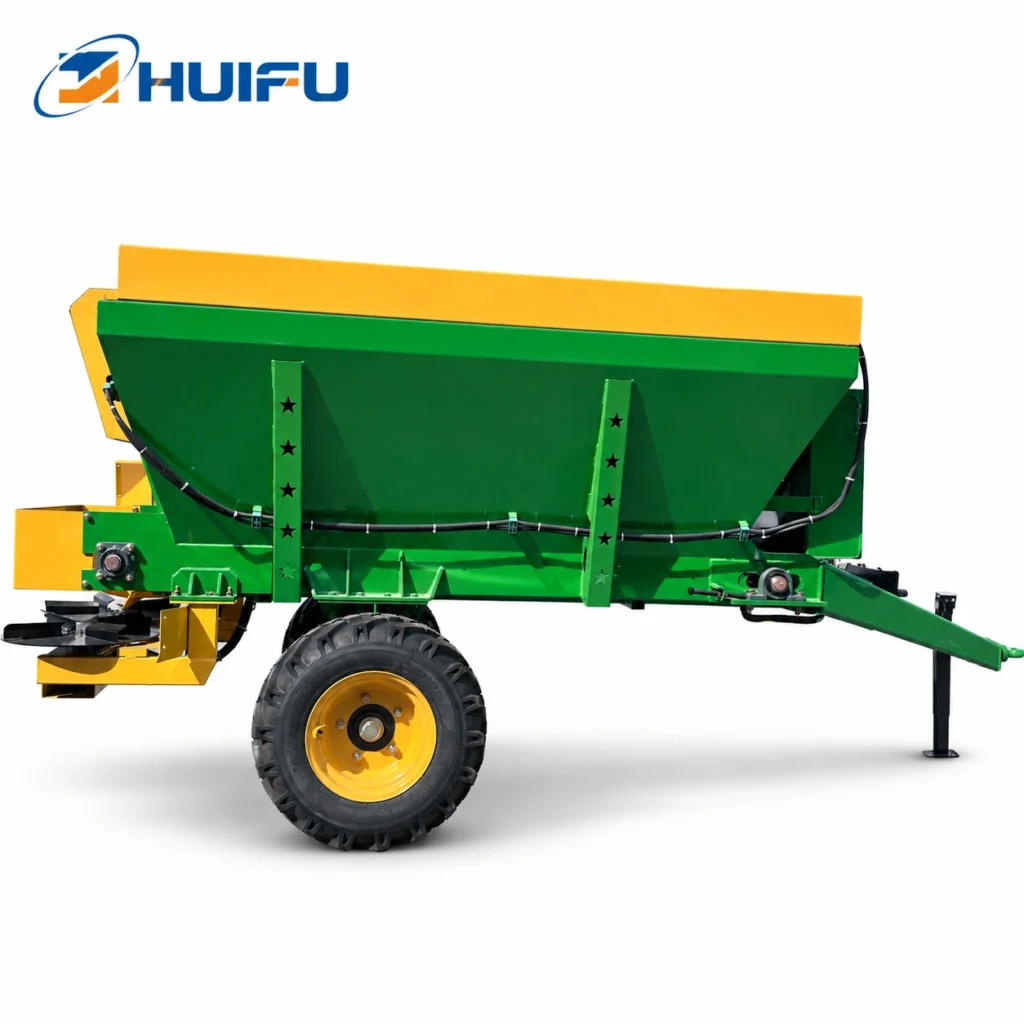
Start with the tractor, not the hopper
Available tractor power is the first filter. The 3m³ spreader is specified for 40 HP or above, while the 5m³ model requires 60 HP or above. Horsepower alone does not confirm a safe match. Check the tractor manual for towing, hitch and hydraulic requirements, then consider terrain, tire traction and the weight of the loaded spreader. A tractor that is adequate on level, firm ground may have less margin on slopes or soft soil.
If your tractor falls below the stated requirement for a model, moving to the smaller spreader is the appropriate starting point. If it meets both thresholds, the choice can shift to productivity and access.
Calculate how much capacity saves in your field
A 5m³ hopper holds about 67% more volume than a 3m³ hopper. That extra capacity can reduce trips to the loading point, but the practical saving depends on field size, application rate, material density and travel distance. Before buying, estimate how many loads each model would require for a typical day and how much time is spent traveling rather than spreading.
A larger hopper is most valuable when fields are extensive or the loading area is far from the work zone. On smaller blocks close to the manure stockpile, faster turning and easier access may be worth more than carrying an additional two cubic meters.
Check gates, lanes and headlands
The 3m³ machine is 1700 mm wide and 4600 mm long. The 5m³ machine increases to 1930 mm wide and 4987 mm long, with a taller overall height of 2100 mm. Measure narrow gates, storage entrances, farm lanes and turning areas before choosing. Allow working clearance rather than treating the machine’s overall width as the minimum opening.
Headland space matters as well. A longer, wider spreader may be efficient in open fields but less convenient in orchards, irregular plots or sites with closely spaced obstacles.
Do not choose by spreading width alone
Both models have a specified adjustable spreading width of 6–12 m. Moving to the 5m³ model therefore increases carrying capacity, not the maximum stated swath. Application quality still depends on material condition, feed consistency, disc settings, travel speed and sensible pass spacing.
If both machines cover your required width, compare the number of refill cycles and the tractor match instead of assuming the larger model will automatically spread wider.
Which model fits which operation
Choose the 3m³ model when
- Your available tractor is rated at 40 HP or above but does not meet the 5m³ model’s 60 HP recommendation.
- Fields, gateways or storage areas favor a narrower and shorter machine.
- Typical jobs are smaller, or the loading point is close enough that refill time is limited.
- Lower loaded weight is important for your soil conditions or operating plan.
Choose the 5m³ model when
- You have a tractor rated at 60 HP or above and have confirmed towing and hydraulic compatibility.
- You regularly cover larger areas or travel farther between the stockpile and the field.
- Reducing refill frequency will improve daily output.
- Your access routes, turning areas and storage space can accommodate the larger dimensions.
Questions to answer before ordering
- What tractor model and available horsepower will operate the spreader?
- What materials will be spread, and what are their typical moisture and bulk density?
- How much material is applied per hectare or acre?
- How far is the loading point from the field?
- What are the narrowest gate, lane and storage clearances?
- Are the fields level and firm, or do slopes and soft ground reduce the safe operating margin?
Review the full specifications for the 3m³ hydraulic trailed dual-disc manure spreader and the 5m³ hydraulic trailed dual-disc manure spreader. When requesting a quotation, include the tractor model, material type, typical application rate and field conditions so the configuration can be checked against the intended work.