
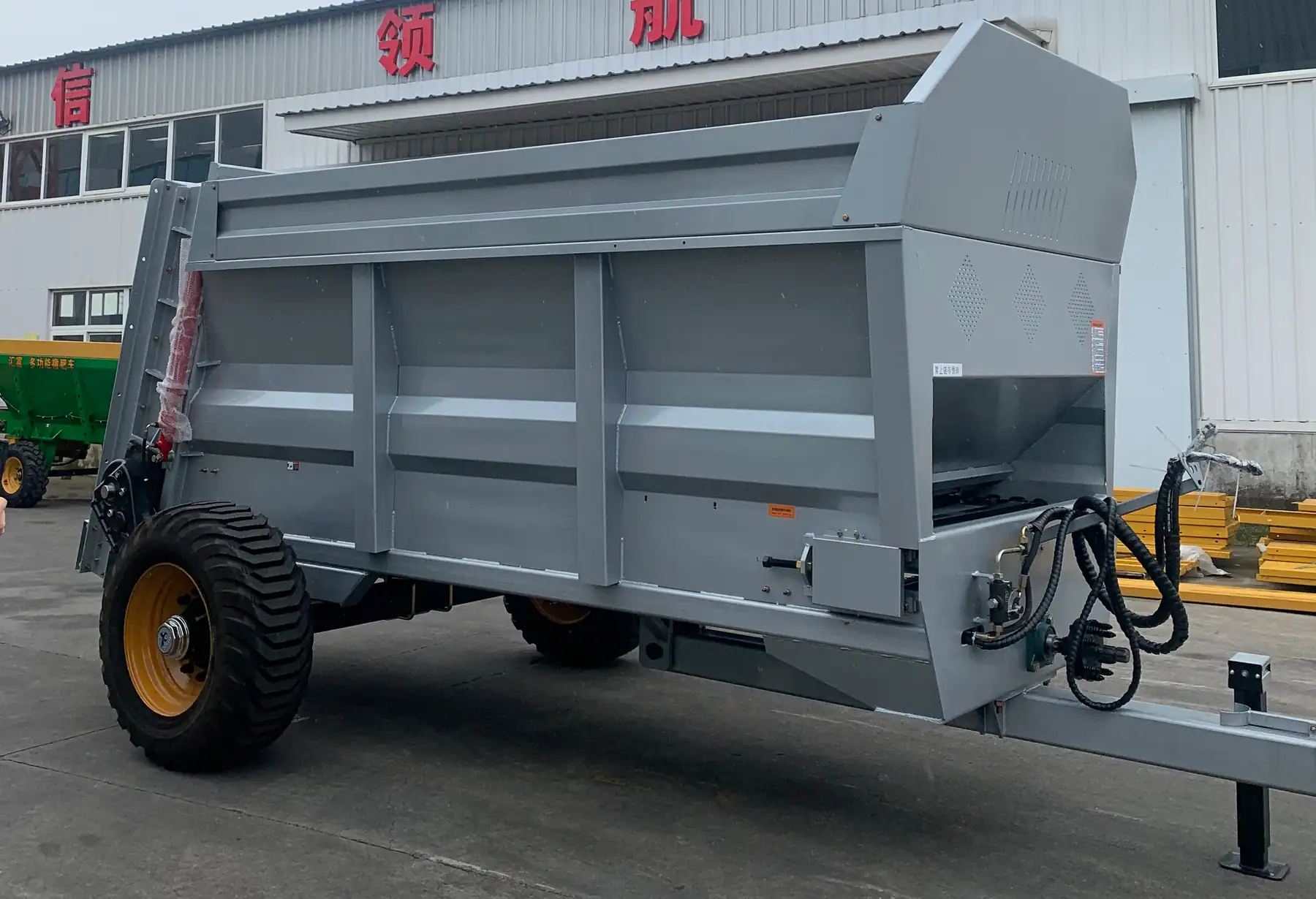
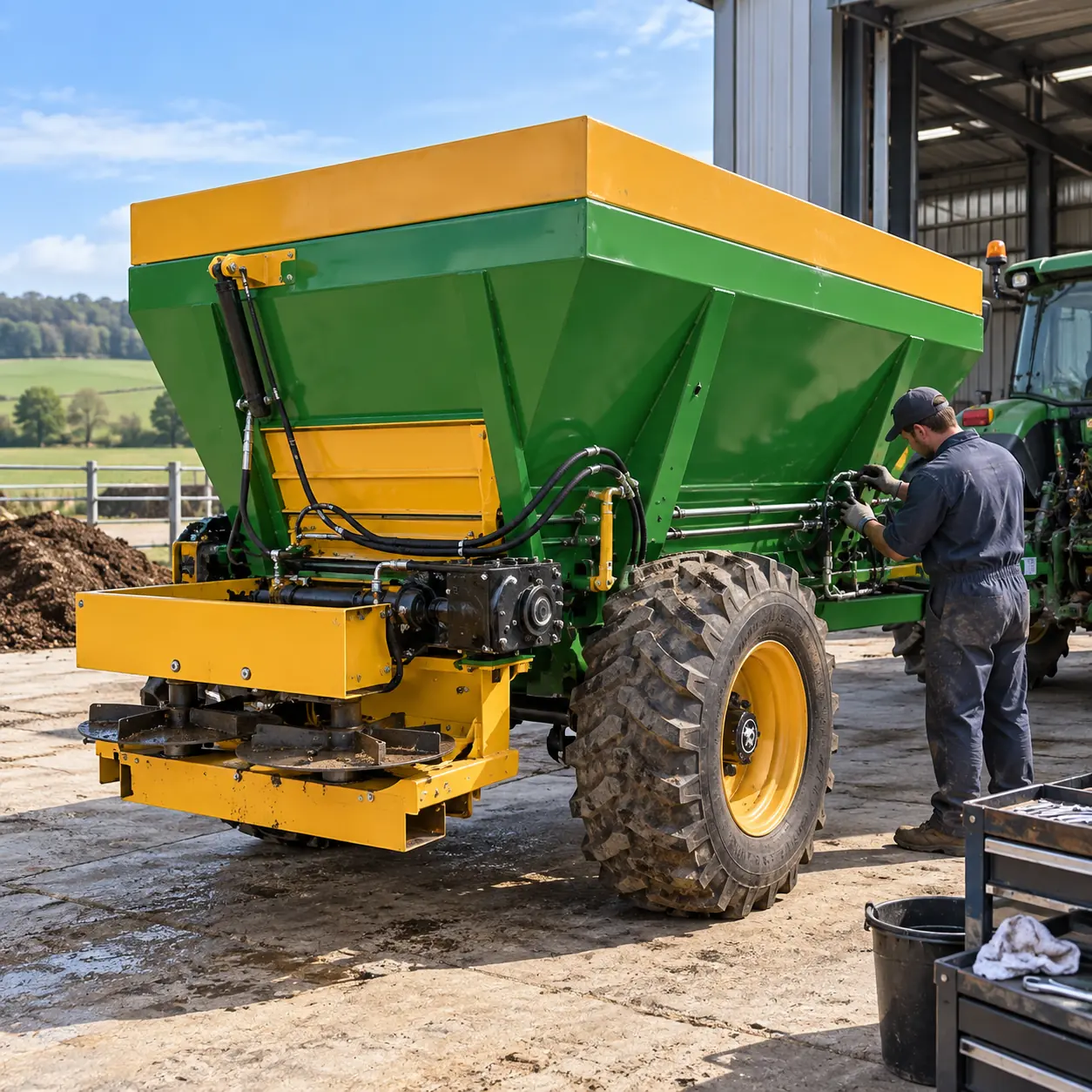
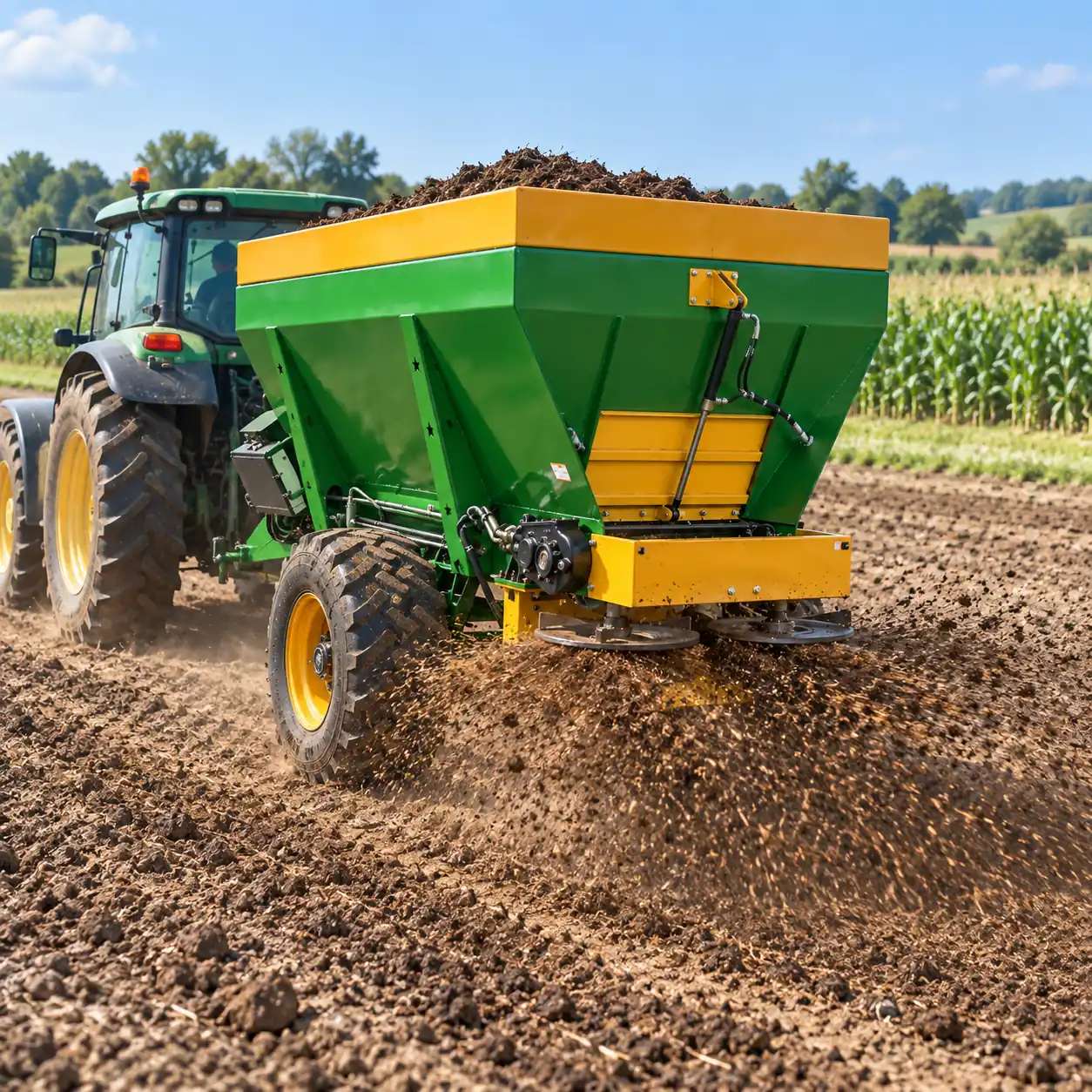
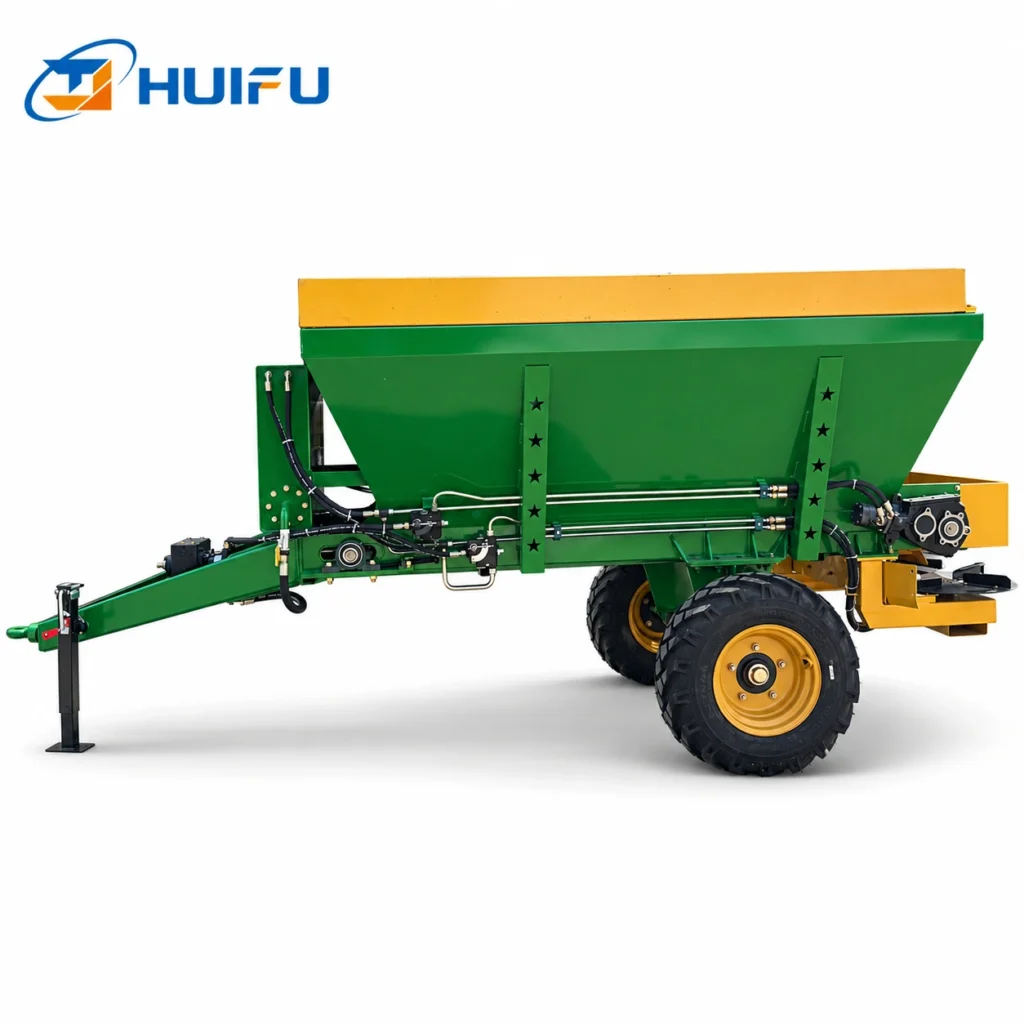
A hydraulic trailed dual-disc manure spreader moves solid fertilizer through a controlled path: the material is carried in the hopper, advanced toward the rear by a chain-board system and broadcast across the field by two rotating discs. Understanding that path makes it easier to set up the machine, identify uneven spreading and choose a model that fits the tractor and workload.
HUIFU’s 3m³ and 5m³ models share this basic arrangement. Both are intended for solid livestock and poultry manure, organic fertilizer and compound fertilizer, with a specified adjustable spreading width of 6–12 m.
The material path from hopper to field
1. The hopper carries the material
The hopper provides temporary storage while the spreader moves through the field. Capacity affects how often the operator must return for another load: the smaller model holds 3m³ and has a 5,000 kg maximum rated load, while the larger model holds 5m³ and has an 8,000 kg maximum rated load.
Volume and weight must be considered separately. Wet manure can weigh much more than a drier, lighter material occupying the same space. Loading should remain within the rated limit, and the load should not compromise the tractor-spreader combination’s safe handling.
2. The chain-board system advances the load
A chain-board pushing system carries material toward the rear spreading assembly. Its job is to maintain delivery to the outlet while the machine is moving. Consistent feeding is important because an interruption or sudden surge changes the amount reaching the discs, even if tractor speed remains unchanged.
3. The rear dual discs distribute the fertilizer
At the rear, material reaches two rotating discs. The discs accelerate and throw it outward to form the working swath. Using two discs supports distribution across both sides of the machine. The actual pattern depends on the fertilizer’s particle size, moisture, tendency to clump, the feed reaching the discs, disc settings and travel speed.
What determines the application pattern
A 6–12 m specification describes the machine’s adjustable spreading range; it does not mean every fertilizer will produce the same pattern at the same setting. Operators should make a short test pass whenever material or field conditions change.
- Material condition: dry, fine fertilizer flows differently from wet or fibrous manure. Break up oversized clumps and remove foreign objects before loading.
- Feed consistency: a steady chain-board delivery helps the discs receive a more uniform flow.
- Travel speed: changing ground speed changes how much material is applied over a given area unless the feed setting is adjusted accordingly.
- Disc operation: disc speed and the condition of the disc blades influence how the material leaves the machine.
- Pass spacing: adjacent passes need sensible overlap based on the observed field pattern, not only the maximum stated width.
- Field conditions: uneven ground, slopes and wind can affect machine stability or the distribution of lighter material.
A practical setup sequence
- Confirm that the tractor meets the model’s matching-power requirement: 40 HP or above for the 3m³ machine and 60 HP or above for the 5m³ machine.
- Inspect the hitch connection, pins, hooks, tires and wheel hubs. Correct looseness or damage before moving the machine.
- Check the spreading discs, blades and transmission components. Remove anything that could obstruct rotation.
- Load an appropriate material and stay within the rated capacity. Account for weight as well as hopper volume.
- Select an initial feed, disc and travel-speed setting suitable for the material and desired application.
- Make a short test pass, observe the pattern across the full swath and adjust one variable at a time.
- Recheck the result when material moisture, field speed or terrain changes.
How to read an uneven pattern
One side spreads more heavily
Stop the machine safely and inspect both discs and blades for buildup, damage or blockage. Confirm that material is reaching both sides of the spreading unit and that paired components are in comparable condition.
The pattern changes during the same pass
Look for irregular material flow in the hopper or interruptions at the chain-board feed. Changes in tractor speed can also alter the application rate. Wet or clumped manure may require more frequent observation than a uniform granular fertilizer.
The swath is narrower than expected
Check material condition, disc operation and settings before increasing travel speed or making multiple changes. The stated 6–12 m width is adjustable and depends on operating conditions; actual performance should be confirmed with a test pass.
Choosing between the 3m³ and 5m³ systems
The spreading principle is the same on both models, so the main differences are tractor requirement, hopper capacity, maximum rated load and overall dimensions. The 3m³ spreader measures 4600 × 1700 × 1770 mm and is specified for 40 HP or above. The 5m³ spreader measures 4987 × 1930 × 2100 mm and is specified for 60 HP or above.
If both fit the tractor, compare refill time and field access. Capacity improves productivity only when the larger machine can move safely through the farm’s gates, lanes and headlands.
Operate from observed results
Uniform spreading comes from the complete system rather than one component. A suitable tractor, controlled loading, consistent chain-board feeding, sound discs and blades, steady travel speed and verified pass spacing all contribute to the final result. Record the settings that work for each material so future setup starts from a tested baseline.
See detailed dimensions and rated capacities for the 3m³ model and 5m³ model. For configuration support, provide the tractor model, fertilizer type and expected field conditions.